
Each year, eight days before their Independence Day, Israel dedicates itself to the remembrance of the Holocaust. So I thought I might share a few of the experiences of my day. In many places, there are signs with the word "eezcor" which means "Remember". At 10am, a loud siren sounds across the country which stops everyone in their tracks. Cars stop driving, people stop walking, speaking, or eating and sit for two minutes. Throughout the day there are ceremonies in many places which continue on into the night. In the center in which I volunteer, they held a two hour ceremony singing songs and talking about the history of the Holocaust. At the University, a second generation Holocaust survivor spoke of her parents' experiences before they came to Israel and started a family. A large crowd of students gathered to listen to her speak and ask questions. Her father had been placed in a work camp and was in the death hut with terrible dysentery when their camp was liberated by the Allies. He nursed himself back to health before making his way to Romania and then later to Israel where he lived on kibbutzes for the remainder of his life. In one particularly horrific anecdote, the speaker told of two SS guards who were captured by the Allies and interrogated by her father because he was the only one around who could speak German. The Germans had been guards at a death camp where the rest of her father's family had been killed. He asked the Allied troops what they planned on doing with the Germans and then he asked if he could have them to kill for himself. The troops complied and he marched the two Germans out and shot them. Years later, when a reporter asked him how he felt about this act of revenge, he said he felt nothing. Nothing because it was so small, so insignificant.
Later, back in our apartment, my roommates were nice enough to tell stories from their own families past. Shai, a descendant of Polish immigrants, had many stories to tell as three of his grandparents were in camps or ghettoes at some point. One grandmother was in a Polish ghetto with the rest of her family for several years as a small child. On the night before the camp was liquidated, her mother made her stay up very late so that she was very tired and slept through most of the rest of the day. When she awoke, there was no one left. Her entire family was gone as was the rest of the Jewish ghetto. She crawled out under one of the fences, setting off an alarm while she did so, and was shot by one of the guards in the leg who mistook her for a small animal. She struggled to walk for miles before finally collapsing and being taken in by a Parish priest who kept her in a monastery for the duration of the war. Another grandmother was being sent to Auschwitz to be exterminated and decided to try to commit suicide by jumping from the train but ended up living and hiding out in the forests and scavenging for food before somehow making her way to Israel. Shai's grandfather escaped to the forests of Belarus and Ukraine where his and 46 other families tried to avoid Russian and German troops and local residents who would shoot them on sight. At the end of the war, there were less than 20 survivors and his grandfather the only one from his family who had survived.
It is rare to hear of such stories out in the open and this day provides that opportunity. The Holocaust is a topic difficult to broach with many people much of the rest of the year. Yet, it is never far from the consciousness of this country. Being here, I am constantly reminded of this Jewish tragedy. I think it will take generations if not more for forgiveness and healing to take place. Holocaust deniers and anti-semitism will forever threaten this process and I can understand how angry Israeli's become to hear of Ahmedinejad's recent speech at a conference on racism. There is good reason for criticism of Israel on several counts regarding its treatment of Israeli-Arabs and Palestinians in the territories but coming from a man who denies the Holocaust is not acceptable. Israel's feeling of vulnerability and the call for its destruction by its enemies are a constant reminder of how close the Jewish people came to extermination. Most days I read in the newspapers here about the imminence of a nuclear holocaust if Iran were to acquire such weapons. This notion is debatable but considering the Jewish people's recent history it is not unreasonable. Thus, the threat seems that much more real and impending for people living with such a historical memory. In this way, I think Israeli militant and self-reliant behavior is much more understandable. There are some in the Arab and Muslim world that are teaching about the Holocaust and attempting to inform a public which knows very little about it. They believe that understanding the Holocaust is one of the keys to understanding Israel. I think that this is not far from the truth.
Wednesday, April 22, 2009

Wednesday, April 15, 2009
One Day in the life of a tourist in Cairo
We stepped from the coolness of the marble-floored foyer into the sunlight of the late morning and made our way toward the heavy of the traffic of Talat Hareb Square, hopped into a cab (without seat-belts like all other taxis in this city), and sped South along the Nile passing some of the lesser hotels and a beautiful white mosque with a giant neon green sign in Arabic. We weaved through throngs of pedestrians, laborers of some sort, as we veered from the Nile and into the depth of the city, the streets becoming narrower, and the crowds more plentiful. I wondered how many traffic deaths occur here each year after narrowly missing a pregnant woman in a head to toe robe complete with a mask to cover her face. After several minutes of standstill traffic we eased onto a large palm-tree lined boulevard which would have been a beautiful view into the distance except for all of the smog which prevents seeing any more than a kilometer or so. After a particularly harrowing bit of driving which seemed much too fast for maneuvering in and out of unmarked lanes, amongst lorries, cars and buses of all types and sizes, and just missing pedestrians hurrying across the street, the first pyramid rises out of nowhere. It is hidden by a particularly shabby apartment building until you are almost on it and then it is impossible to avert your eyes. We exited the taxi, dropped the money on the passenger seat as is the Cairo custom and walked quickly the other way while the driver yelled after us. And then came the tourists, the Westerners, and lines and photographs and litter, sand, the desert and sun while the pyramids, patient as ever, are unmoved by all of the hubbub at their feet. The Sphinx, their guardian, watches a putrid Giza, full of more tourists, and more venders, and litter and photographs, surely wary of what has happened over the last 50 years. This city of 20 million has spread out and drawn in the population from the countryside as the rural lifestyle is no longer sustainable and people from every corner of this country come here to find a way to live. The day will come soon when the ancient pyramids are surrounded on all sides by Cairo and at last lose their link to the desert.
Two English teenage girls wearing miniskirts and sports bras pass and I think they seem even more out of place than the pyramids. Almost all women wear a head scarf and many have chosen or are forced to put on the restrictive burqa. We lunched at a buffet restaurant with hundreds of Italian retirees and for a moment the power comes on and the air conditioners begint to whir above us--heaven. It is hard to think how this place is bearable in summer. We haggle over the price of a horse and camel ride, threatening to walk out, the price comes down, threaten again, lower, and it seems to me like a ridiculous script that each has memorized the words to but must recite in order to get to the same conclusion every time. Finally, riding into the desert, trotting then galloping so fast I feel a little crazy with adrenaline and on the top of the ridge overlooking the pyramids, the city and the sliver of desert remaining to the South there is silence--no cars, no tourists, no buses, just a few moments of calm before the call to prayer beckons us back into the city. This time, I'm on the camel, with the boy, our guide, riding through a poverty-stricken neighborhood, whole families sitting on the doorstep. Mothers cover their faces as we pass and I see three boys looking at a comic book, pointing at the pictures and an old woman, her feet too swollen to walk on a mat proferring a hookah for passersby. The old Giza cemetary is behind her, waiting, and the pyramids in the distance but she smiles at us anyway. Maybe because he is just a boy but the tour guide hides nothing and rides this path daily for all to see and just like the rest of this city is unashamed. Cairo is nothing if it is not open and honest.
Another cab and more traffic, a golden mosque opposite a canal with sewage and little boys on a motorbike waving and smiling, riding on the sidewalk. Then we turn onto the highway and pass the largest housing development I have ever seen. Red brick buildings for miles on end where millions must live and each is still under development, one story on top of another, then along the Nile again, the Marriot, Four Seasons, and Hyatt rising elegantly if not somewhat ridiculously beside the squalid buildings to their left and right. Along the waterfront, young couples canoodle out the view of their parents and neighborhoods, never kissing, but always talking closely, leaning on each other and touching hands. Then turning away from the river we move into the neighborhoods of metalworkers, steel and scrap everywhere, men with black hands and faces, sitting outside enjoying the cool moments at the end of the day, sipping tea, smoking cigarettes. The woodworkers come next, raw lumber protruding onto the street, tables and chairs, cabinets waiting for delivering and thoughts of my Father enter my mind. A girl, unscarfed, flies a golden kite in a busy square, her hair whipping in the wind. Finally, the shoe district and store after store for blocks of shoes of all colors, types and sizes all displayed for everyone to see. There are many shoppers. Close to home now, and we pass one of the many policemen, black uniformed, we have seen on our corner, on every corner, sitting, standing, waiting, praying, smoking, then the marble floor, the rickety elevator, the nostalgic paintings of Arabian days and nights long gone, key in keyhole, head on pillow.
 Policeman on Camel
 typical Cairo traffic
 Tucker's Camel's name was Michael Jackson

 poor neighborhood in Cairo
 1st Mosque built in Cairo in the 9th Century
 Ottoman Mosque
Two English teenage girls wearing miniskirts and sports bras pass and I think they seem even more out of place than the pyramids. Almost all women wear a head scarf and many have chosen or are forced to put on the restrictive burqa. We lunched at a buffet restaurant with hundreds of Italian retirees and for a moment the power comes on and the air conditioners begint to whir above us--heaven. It is hard to think how this place is bearable in summer. We haggle over the price of a horse and camel ride, threatening to walk out, the price comes down, threaten again, lower, and it seems to me like a ridiculous script that each has memorized the words to but must recite in order to get to the same conclusion every time. Finally, riding into the desert, trotting then galloping so fast I feel a little crazy with adrenaline and on the top of the ridge overlooking the pyramids, the city and the sliver of desert remaining to the South there is silence--no cars, no tourists, no buses, just a few moments of calm before the call to prayer beckons us back into the city. This time, I'm on the camel, with the boy, our guide, riding through a poverty-stricken neighborhood, whole families sitting on the doorstep. Mothers cover their faces as we pass and I see three boys looking at a comic book, pointing at the pictures and an old woman, her feet too swollen to walk on a mat proferring a hookah for passersby. The old Giza cemetary is behind her, waiting, and the pyramids in the distance but she smiles at us anyway. Maybe because he is just a boy but the tour guide hides nothing and rides this path daily for all to see and just like the rest of this city is unashamed. Cairo is nothing if it is not open and honest.
Another cab and more traffic, a golden mosque opposite a canal with sewage and little boys on a motorbike waving and smiling, riding on the sidewalk. Then we turn onto the highway and pass the largest housing development I have ever seen. Red brick buildings for miles on end where millions must live and each is still under development, one story on top of another, then along the Nile again, the Marriot, Four Seasons, and Hyatt rising elegantly if not somewhat ridiculously beside the squalid buildings to their left and right. Along the waterfront, young couples canoodle out the view of their parents and neighborhoods, never kissing, but always talking closely, leaning on each other and touching hands. Then turning away from the river we move into the neighborhoods of metalworkers, steel and scrap everywhere, men with black hands and faces, sitting outside enjoying the cool moments at the end of the day, sipping tea, smoking cigarettes. The woodworkers come next, raw lumber protruding onto the street, tables and chairs, cabinets waiting for delivering and thoughts of my Father enter my mind. A girl, unscarfed, flies a golden kite in a busy square, her hair whipping in the wind. Finally, the shoe district and store after store for blocks of shoes of all colors, types and sizes all displayed for everyone to see. There are many shoppers. Close to home now, and we pass one of the many policemen, black uniformed, we have seen on our corner, on every corner, sitting, standing, waiting, praying, smoking, then the marble floor, the rickety elevator, the nostalgic paintings of Arabian days and nights long gone, key in keyhole, head on pillow.
 Policeman on Camel
 typical Cairo traffic
 Tucker's Camel's name was Michael Jackson
 poor neighborhood in Cairo
 1st Mosque built in Cairo in the 9th Century
 Ottoman Mosque
Thursday, April 2, 2009
Amman
Tucker, Rikke and I combined for another weekend adventure to Amman a few weeks ago. Rikke, my Danish friend, in case you don't read every one of these, went on an organized tour of Jordan several years ago to visit NGOs working towards peace in the Middle East. While there, she met a young man named Mohammed (go figure). They became quick friends and so she had wanted to visit him this year and used Tucker and I's enthusiasm for visiting Amman as a good excuse. On the plus side for us, we got a free place to stay and a great tour guide in Mohammed. Tucker and I left Haifa at noon on Thursday, arrived to the border around 330 though it is only about 50 kilometers from Haifa. This is due to the fact that there is not one direct way to cross the border. No buses even go to the border crossing. It is incredible that two countries that share so much border have so few opportunities for interaction. Neither Jordanians nor Israelis are very keen on travel to the "other" side. Both have fears of violence directed at them and feelings of discomfort which might be well founded across that imaginary line. It took a couple of hours to go through the border crossing itself which included an hour to wait for a bus to drive us literally 100 yards across a bridge. They will not allow you to walk. We then hired a cab once in Jordan to drive us the two hours to the capital city if Amman, population 2 million.
Immediately upon entering the Jordanian countryside and the small towns there, a distinct difference is apparent. The first thing noted is the poverty and neglect of the Jordan Valley. The infrastructure is not nearly the standard that we are used to in Israel and then the dress and architecture also set this place off from only a few hundred yards across the Jordan River. The taxi driver, though, had blue tooth in his car and a flat screen dvd player for a rearview mirror. Not something that we have ever found in Israel. The driver told us that he was a language teacher and a college graduate but that he couldn't provide for his family that way and decided to become a cab driver instead. We took a short cut through the large hills that line the valley and riding up and down the steep one lane road at much too fast a speed was making us all a little queasy until Rikke demanded that he slow down. He laughed and gave Rikke a hard time for much of the rest of the trip.
We arrived to Amman around 8 pm (an 8 hour trip that only took us about 100 miles as the crow flies). We met Mohammed and his friend Mohammed. Not joking. We went to a restaurant in one of the very modern neighborhoods that has a pedestrian mall where a lot of the more affluent crowd likes to spend their evenings. We ate a very large meal at one of Mohammed's favorite restaurants which only cost about $30 for all five of us. We then walked around the corner to a coffee shop and smoked hookah/nargila/shisha (pretty much the national past-time in Arab countries), talked and sipped Arabic coffee (where the grounds remain in your cup and you let the coffee sit for a few minutes to allow the grounds to settle at the bottom, making for very strong coffee). We returned to Mohammed's 3 bedroom apartment in which his family used to live. He is the only one that still remains in Amman as his brother has moved to Portland, Oregon, his father to the south of the country while his mother has moved to Syria to live with her new Iraqi husband who cannot get a visa to live in Jordan. Mohammed comes from an upper middle class family, is a 26 year-old computer engineer working for an international company and speaks perfect English which he apparently learned entirely from movies.
We fell quickly asleep even with all of the caffeine after such a long day of travel. In the morning, we ate a small breakfast and quickly headed toward the Old City where we hoped to do some shopping in the large bazaar. We walked around all day, stopping into a variety of stores and restaurants and coffee shops. The whole day we didn't see one tourist, which is a strange thing being so used to tourists in this part of the world. We got lots of strange looks and a lot of smiles. The market was mainly populated by men and the women that were there were covered much more fully than the women we had seen elsewhere in the city. Mohammed told us that this area was one of the poorest areas and consequently one of the most religious. For dinner, we had the pleasure of dining at a restaurant built during the height of the Pan-Arab movement which still retains some of this influence until today. The decor seemed an idealized version of the Arabia of old and thus is frequented by many tourists though the business continued to attract customers from all aspects of the city. We ate another huge meal for far too cheap and headed back to Mohammed's.
On Saturday, Mohammed took us around Amman to see some of the landmarks, one of which was the new Mosque built in memory of the late King Hussein. The mosque was immaculate and whiter and cleaner than any mosque I have ever seen though I feel like it is underused because of its location so far away from residential neighborhoods. But the view from the top of the hill on which it is built is breathtaking. We got our own private tour from a couple of custodial staff, but before we were allowed in, Rikke had to wrap a black shawl around her head which she didn't like considering Tucker and I needed to extra clothing thrust upon us but she bore her indignation silently. Later that night we went and smoked hookah/shisha/nargila again and spoke with Mohammed about the politics of the Middle East and especially the Arab-Israeli conflict for a long time. It was kind of refreshing to hear the completely opposite perspective from what I get in Israel and found myself agreeing with him on several important points though obviously not everything. It is amazing how dominant the competing arguments are in this dialectic. I find it is very difficult to argue with either side on the basic tenets of their arguments as they are each very well versed in their own particular argument. The difference mainly comes down to history and morality and within each viewpoint, everything they argue makes sense. As I have said in other posts, it is difficult to share some common ground here, to walk the tight rope between the two because this is a much more ideologically tenuous place where one must be critical of each and accept that the starting point for one might be invalid or inconsequential for the other.
Yet, I also find that simplistic explanations such as that two opposing sides have been polarized and are unwilling to find some common ground, captures very little of the truth and complexity of this region and conflict. Truly, it is hard to distinguish between what is a consequence of the conflict and its causes because so often they are the same after more than 60 years of violence and antagonism. And yet, sometimes I think we see the conflict and division where it does not exist in the first place and thus it is conjured and reinforced where it is other factors like culture, history, or socioeconomics at work. So maybe the mere fact that I stress this conflict in these postings and in how I view this region, I am calling up division and conflict in many places where it does not exist or not to such a high degree, thereby reinforcing such notions in the minds of many. Sorry if that was a bit obscure but I thought I should try to get some of my thoughts or fragments of thoughts down.
Next time... Cairo.
 Amman Old City
 Balcony Coffee Shop
 Lunch Restaurant where the second floor was 4 feet tall
 Rikke
Rikke
 Mohammed
 King Hussein Mosque
 Reading the Koran in the mosque (they had English translations)
 Hussein Mosque at sunset
Immediately upon entering the Jordanian countryside and the small towns there, a distinct difference is apparent. The first thing noted is the poverty and neglect of the Jordan Valley. The infrastructure is not nearly the standard that we are used to in Israel and then the dress and architecture also set this place off from only a few hundred yards across the Jordan River. The taxi driver, though, had blue tooth in his car and a flat screen dvd player for a rearview mirror. Not something that we have ever found in Israel. The driver told us that he was a language teacher and a college graduate but that he couldn't provide for his family that way and decided to become a cab driver instead. We took a short cut through the large hills that line the valley and riding up and down the steep one lane road at much too fast a speed was making us all a little queasy until Rikke demanded that he slow down. He laughed and gave Rikke a hard time for much of the rest of the trip.
We arrived to Amman around 8 pm (an 8 hour trip that only took us about 100 miles as the crow flies). We met Mohammed and his friend Mohammed. Not joking. We went to a restaurant in one of the very modern neighborhoods that has a pedestrian mall where a lot of the more affluent crowd likes to spend their evenings. We ate a very large meal at one of Mohammed's favorite restaurants which only cost about $30 for all five of us. We then walked around the corner to a coffee shop and smoked hookah/nargila/shisha (pretty much the national past-time in Arab countries), talked and sipped Arabic coffee (where the grounds remain in your cup and you let the coffee sit for a few minutes to allow the grounds to settle at the bottom, making for very strong coffee). We returned to Mohammed's 3 bedroom apartment in which his family used to live. He is the only one that still remains in Amman as his brother has moved to Portland, Oregon, his father to the south of the country while his mother has moved to Syria to live with her new Iraqi husband who cannot get a visa to live in Jordan. Mohammed comes from an upper middle class family, is a 26 year-old computer engineer working for an international company and speaks perfect English which he apparently learned entirely from movies.
We fell quickly asleep even with all of the caffeine after such a long day of travel. In the morning, we ate a small breakfast and quickly headed toward the Old City where we hoped to do some shopping in the large bazaar. We walked around all day, stopping into a variety of stores and restaurants and coffee shops. The whole day we didn't see one tourist, which is a strange thing being so used to tourists in this part of the world. We got lots of strange looks and a lot of smiles. The market was mainly populated by men and the women that were there were covered much more fully than the women we had seen elsewhere in the city. Mohammed told us that this area was one of the poorest areas and consequently one of the most religious. For dinner, we had the pleasure of dining at a restaurant built during the height of the Pan-Arab movement which still retains some of this influence until today. The decor seemed an idealized version of the Arabia of old and thus is frequented by many tourists though the business continued to attract customers from all aspects of the city. We ate another huge meal for far too cheap and headed back to Mohammed's.
On Saturday, Mohammed took us around Amman to see some of the landmarks, one of which was the new Mosque built in memory of the late King Hussein. The mosque was immaculate and whiter and cleaner than any mosque I have ever seen though I feel like it is underused because of its location so far away from residential neighborhoods. But the view from the top of the hill on which it is built is breathtaking. We got our own private tour from a couple of custodial staff, but before we were allowed in, Rikke had to wrap a black shawl around her head which she didn't like considering Tucker and I needed to extra clothing thrust upon us but she bore her indignation silently. Later that night we went and smoked hookah/shisha/nargila again and spoke with Mohammed about the politics of the Middle East and especially the Arab-Israeli conflict for a long time. It was kind of refreshing to hear the completely opposite perspective from what I get in Israel and found myself agreeing with him on several important points though obviously not everything. It is amazing how dominant the competing arguments are in this dialectic. I find it is very difficult to argue with either side on the basic tenets of their arguments as they are each very well versed in their own particular argument. The difference mainly comes down to history and morality and within each viewpoint, everything they argue makes sense. As I have said in other posts, it is difficult to share some common ground here, to walk the tight rope between the two because this is a much more ideologically tenuous place where one must be critical of each and accept that the starting point for one might be invalid or inconsequential for the other.
Yet, I also find that simplistic explanations such as that two opposing sides have been polarized and are unwilling to find some common ground, captures very little of the truth and complexity of this region and conflict. Truly, it is hard to distinguish between what is a consequence of the conflict and its causes because so often they are the same after more than 60 years of violence and antagonism. And yet, sometimes I think we see the conflict and division where it does not exist in the first place and thus it is conjured and reinforced where it is other factors like culture, history, or socioeconomics at work. So maybe the mere fact that I stress this conflict in these postings and in how I view this region, I am calling up division and conflict in many places where it does not exist or not to such a high degree, thereby reinforcing such notions in the minds of many. Sorry if that was a bit obscure but I thought I should try to get some of my thoughts or fragments of thoughts down.
Next time... Cairo.
 Amman Old CityBalcony Coffee Shop
 Lunch Restaurant where the second floor was 4 feet tall
 Rikke
Rikke Mohammed
 King Hussein MosqueReading the Koran in the mosque (they had English translations)
 Hussein Mosque at sunset
Thursday, March 26, 2009
Jerusalem and the Negev II
So we are nearing midterms in the semester and I realize I haven't posted about the second semester at all and it has be two months since our trip to Europe. This semester, if you can imagine, has been filled with travel even moreso than its predecessor. On top of this, we have a couple of weeks of break coming up in which more travels are planned. I am doing everything that I possibly can before I leave because it might be a long while before I can just hop on over to Jerusalem, the Dead Sea, the Sea of Galilee or for that matter walk down the mountain to the warm waters of the Mediterranean.
So I want to say here and now that Jerusalem is far and away my favorite city in Israel. It's not the religious thing or the mix of cultures or how old it is or how important it is to nearly half the world. It's that you can walk everywhere. Living on the top of a mountain in Haifa doesn't allow us to walk, well, pretty much anywhere in Haifa. The University is the last thing before Carmel National Park begins so we have to take a 45 minute bus-ride just to get to downtown. It should take about 10-15 minutes but since all of the roads are a series of switchbacks down the mountain and the traffic is terrible, it is a mind-numbingly long trip. Jerusalem, on the other hand, is flat and easily walkable. On my most recent trip, I attended a Idan Reichal concert, whose band is made up of musicians from all over the world and play what can only be described as "world" music (lots of drums, no one wears shoes, and lots of dredlocks). Really a very good band, though. We went for free on a ticket sponsored by MASA, a group dedicated to continue the "in-gathering of the exiles." Which really means that there were about 7,000 American-Jewish college students on vacation in attendance. It was a rather interesting experience.
Tucker and I stayed with a friend, Rikke, for the next few days and walked everywhere we possibly could: the Old City, downtown, cafes, bars, falafel shops, markets, East Jerusalem and even walked around the Old City on top of the ramparts and outer walls. It was especially interesting to see down into all of the backyards and alleys, schoolyards and into homes. It is easy to forget in the hustle and bustle of the markets that some people still live in the Old City and their ancestors have done so for centuries. We made a concerted effort to walk around the Muslim Quarter which has a very different feel than its counterparts. Then we proceeded into East Jerusalem and ate a large Arab dinner at a very nice hotel that was full of Arabs and Swedes (no idea why). The line is very clear where these neighborhoods begin and end. No one needs to tell you, it's impossible to all of a sudden walk into a Muslim neighborhood and not know it. The people dress much differently and everything is written in Arabic and you hear Arabic being spoken. On top of that, the smells are rather different as is the food and there are no American brands or chains at least from what I could tell. We were a rather conspicuous group so there was a lot of staring involved as well: two six foot plus Americans and Rikke, our Danish friend, whose facial piercings and bright blond dredlocks make her stick out pretty much anywhere and East or West, Jewish or Muslim, there is no shortage of gawkers when she walks by.
The next weekend, the International School organized a trip to the Arava Desert which is located just North of Eilat and part of the larger Negev Desert. 80 international school students spent a night sleeping under the stars on some rocky ground just beside a row of mountains to the West. The weather was beautiful: hot and sunny so the hiking was great. We grilled all sorts of meat the first night and ate smores and sang songs around a giant campfire. We were forced to sign up for half-hour night watches (who we were watching out for I have no idea but one of the guides told a few stories of Egyptians coming across the border) and I signed up last so I got the 330-400 shift. The upside was that I was having a hard time sleeping anyway so I stayed up, read by the fire and got to watch the sun rise over Jordan in the desert. The third day we spent on the beach in Eilat enjoying the warm water and sneaking into the 5 star hotels to steal some of the "good life" in their flower or crown-chaped pools with fountains galore.
The last thing I want to say is that I am proud to report, for those of you who don't already know, that the Irish Rugby national team won the Six Nations Grand Slam this year for the first time since 1954. I was able to watch a number of the games, the first of which was when we were in Dublin, although I missed the last one against Wales where it came down to a last second kick to decide the winner. Go Irish!
 Greek Orthodox proceeding from their Cathedral in the Old City
 I think Che would have liked this shop in East Jerusalem
 Muslim Quarter children playing in the street
 Tucker, Rikke (pronounced Rega), and I. Gilded Dome of the Rock in the background.
 In the Old City Wall
 Looking out over the Negev (Jordanian Mountains in the distance)


So I want to say here and now that Jerusalem is far and away my favorite city in Israel. It's not the religious thing or the mix of cultures or how old it is or how important it is to nearly half the world. It's that you can walk everywhere. Living on the top of a mountain in Haifa doesn't allow us to walk, well, pretty much anywhere in Haifa. The University is the last thing before Carmel National Park begins so we have to take a 45 minute bus-ride just to get to downtown. It should take about 10-15 minutes but since all of the roads are a series of switchbacks down the mountain and the traffic is terrible, it is a mind-numbingly long trip. Jerusalem, on the other hand, is flat and easily walkable. On my most recent trip, I attended a Idan Reichal concert, whose band is made up of musicians from all over the world and play what can only be described as "world" music (lots of drums, no one wears shoes, and lots of dredlocks). Really a very good band, though. We went for free on a ticket sponsored by MASA, a group dedicated to continue the "in-gathering of the exiles." Which really means that there were about 7,000 American-Jewish college students on vacation in attendance. It was a rather interesting experience.
Tucker and I stayed with a friend, Rikke, for the next few days and walked everywhere we possibly could: the Old City, downtown, cafes, bars, falafel shops, markets, East Jerusalem and even walked around the Old City on top of the ramparts and outer walls. It was especially interesting to see down into all of the backyards and alleys, schoolyards and into homes. It is easy to forget in the hustle and bustle of the markets that some people still live in the Old City and their ancestors have done so for centuries. We made a concerted effort to walk around the Muslim Quarter which has a very different feel than its counterparts. Then we proceeded into East Jerusalem and ate a large Arab dinner at a very nice hotel that was full of Arabs and Swedes (no idea why). The line is very clear where these neighborhoods begin and end. No one needs to tell you, it's impossible to all of a sudden walk into a Muslim neighborhood and not know it. The people dress much differently and everything is written in Arabic and you hear Arabic being spoken. On top of that, the smells are rather different as is the food and there are no American brands or chains at least from what I could tell. We were a rather conspicuous group so there was a lot of staring involved as well: two six foot plus Americans and Rikke, our Danish friend, whose facial piercings and bright blond dredlocks make her stick out pretty much anywhere and East or West, Jewish or Muslim, there is no shortage of gawkers when she walks by.
The next weekend, the International School organized a trip to the Arava Desert which is located just North of Eilat and part of the larger Negev Desert. 80 international school students spent a night sleeping under the stars on some rocky ground just beside a row of mountains to the West. The weather was beautiful: hot and sunny so the hiking was great. We grilled all sorts of meat the first night and ate smores and sang songs around a giant campfire. We were forced to sign up for half-hour night watches (who we were watching out for I have no idea but one of the guides told a few stories of Egyptians coming across the border) and I signed up last so I got the 330-400 shift. The upside was that I was having a hard time sleeping anyway so I stayed up, read by the fire and got to watch the sun rise over Jordan in the desert. The third day we spent on the beach in Eilat enjoying the warm water and sneaking into the 5 star hotels to steal some of the "good life" in their flower or crown-chaped pools with fountains galore.
The last thing I want to say is that I am proud to report, for those of you who don't already know, that the Irish Rugby national team won the Six Nations Grand Slam this year for the first time since 1954. I was able to watch a number of the games, the first of which was when we were in Dublin, although I missed the last one against Wales where it came down to a last second kick to decide the winner. Go Irish!
 Greek Orthodox proceeding from their Cathedral in the Old City
 I think Che would have liked this shop in East Jerusalem
 Muslim Quarter children playing in the street
 Tucker, Rikke (pronounced Rega), and I. Gilded Dome of the Rock in the background.
 In the Old City Wall
 Looking out over the Negev (Jordanian Mountains in the distance)


Wednesday, March 11, 2009
Dublin and Paris
Hello Again,
I apologize for the length between the last entry and this one. It has been a month and a half and there is much to tell so I'll split a couple of them up over the next week. The first topic to address is our (Rommates: Tucker, Adam and I) trip to Europe over our semester break. We spent two weeks mooching off of friends and sleeping on floors in order to enjoy the best that Europe has to offer.
The first stop was Paris, where we spent 4 days staying at a friend's parents' house in the suburbs. The Ganem-Rosens, a family with Jewish/American/Tunisian background lives in a very quaint little suburb only a 20 minute train ride from the center of the city. Their lovely daughter, Miriam, is a great friend of ours who attended Haifa University with us last semester. The Ganem-Rosens were more than hospitable, providing beds (a luxury when traveling like we were), hot meals, hotter showers and lovely evening conversation around the dinner table. Shira, the mother, even provided us with a ride, after an interesting battery-jump episode, to Versailles during the obligatory transportation worker strike. If you visit France and avoid all such socialist-inspired strikes, consider yourself lucky. Adam and Tucker had never done much or any sightseeing in Paris so we hit up all the biggies: Eiffel Tower, Sacre de Couer, Arc du Triomphe, Notre Dame, Versailles, Musee D'Orsay, the Latin Quarter, and miles upon miles of lovely wintry streets in the center and suburbs of Paris. I had seen all of these things before but I adored them just as much as the first time. I truly believe that Paris is the best city for a tourist in the world. My only wish would have been to spend more time finding all the nooks and crannies of the idiosyncratic neighborhoods and areas of this city. Alas, it'll have to for next time.
We arrived in Dublin on a traditional rainy day and proceeded onto the University College Dublin sports center for me to reunite with my old squash team for the biggest tournament of the year. My legs and lungs were a bit rusty but I am happy to report that the UCD "A" team captured the Intervarsities for the second straight year after losing it for the 10 previous to crosstown rival Trinity. The weather proceeded to turn rather nasty and it began to snow and accumulate on the ground for the first time in 10 years. Global warming, what a crock? Just kidding, Dad. I am so happy we got to experience this rarity yet it made the trip a bit more difficult as we were snowed in on our flight back to France and were forced to spend an extra 5 days in Dublin. I know, woe is me. We got the opportunity to watch Ireland beat France in rugby in the Six Nations tournament at a loud and drunken Irish pub. An amazing experience for anyone. Go Irish! The rest of our trip consisted of seeing many of the tourist attractions Dublin and surrounds have to offer including the Guinness factory, the Jameson Distillery, Kilmainham Jail (wonderful!), Trinity College, St. Stephen's Green, the the Wicklow Mountains. As you will see in the pictures, I ain't lyin' about the snow. The rest of the time, I was able to show Adam and Tucker much of the Dublin (places and people) I came to know and love last year.
Overall, it was a wonderful trip which also included: watching Adam get into a snowball fight with three 10 year-old girls (it's still up in the air who won), Tucker wearing a blanket as a dress to stay warm in the mornings, three strapping, cocky Americans trying to push a car up a driveway in paris and failing miserably, many arguments over directions and politics, and maybe a pint or two.
Peace,
Nick
 Ganem-Rosen Paris home
 Crepe action

 Merry-Go-Round with Notre Dame in the background
 Tucker & Adam

 Sacre de Couer on a beautiful day
 Tucker's Dublin skirt
 Pouring our own
 Nothing like a fresh poured Guinness
 The Irish call this weather- "Shite."
 That didn't stop us though
 Napping
  Glendalough
 A truly converted republican
I apologize for the length between the last entry and this one. It has been a month and a half and there is much to tell so I'll split a couple of them up over the next week. The first topic to address is our (Rommates: Tucker, Adam and I) trip to Europe over our semester break. We spent two weeks mooching off of friends and sleeping on floors in order to enjoy the best that Europe has to offer.
The first stop was Paris, where we spent 4 days staying at a friend's parents' house in the suburbs. The Ganem-Rosens, a family with Jewish/American/Tunisian background lives in a very quaint little suburb only a 20 minute train ride from the center of the city. Their lovely daughter, Miriam, is a great friend of ours who attended Haifa University with us last semester. The Ganem-Rosens were more than hospitable, providing beds (a luxury when traveling like we were), hot meals, hotter showers and lovely evening conversation around the dinner table. Shira, the mother, even provided us with a ride, after an interesting battery-jump episode, to Versailles during the obligatory transportation worker strike. If you visit France and avoid all such socialist-inspired strikes, consider yourself lucky. Adam and Tucker had never done much or any sightseeing in Paris so we hit up all the biggies: Eiffel Tower, Sacre de Couer, Arc du Triomphe, Notre Dame, Versailles, Musee D'Orsay, the Latin Quarter, and miles upon miles of lovely wintry streets in the center and suburbs of Paris. I had seen all of these things before but I adored them just as much as the first time. I truly believe that Paris is the best city for a tourist in the world. My only wish would have been to spend more time finding all the nooks and crannies of the idiosyncratic neighborhoods and areas of this city. Alas, it'll have to for next time.
We arrived in Dublin on a traditional rainy day and proceeded onto the University College Dublin sports center for me to reunite with my old squash team for the biggest tournament of the year. My legs and lungs were a bit rusty but I am happy to report that the UCD "A" team captured the Intervarsities for the second straight year after losing it for the 10 previous to crosstown rival Trinity. The weather proceeded to turn rather nasty and it began to snow and accumulate on the ground for the first time in 10 years. Global warming, what a crock? Just kidding, Dad. I am so happy we got to experience this rarity yet it made the trip a bit more difficult as we were snowed in on our flight back to France and were forced to spend an extra 5 days in Dublin. I know, woe is me. We got the opportunity to watch Ireland beat France in rugby in the Six Nations tournament at a loud and drunken Irish pub. An amazing experience for anyone. Go Irish! The rest of our trip consisted of seeing many of the tourist attractions Dublin and surrounds have to offer including the Guinness factory, the Jameson Distillery, Kilmainham Jail (wonderful!), Trinity College, St. Stephen's Green, the the Wicklow Mountains. As you will see in the pictures, I ain't lyin' about the snow. The rest of the time, I was able to show Adam and Tucker much of the Dublin (places and people) I came to know and love last year.
Overall, it was a wonderful trip which also included: watching Adam get into a snowball fight with three 10 year-old girls (it's still up in the air who won), Tucker wearing a blanket as a dress to stay warm in the mornings, three strapping, cocky Americans trying to push a car up a driveway in paris and failing miserably, many arguments over directions and politics, and maybe a pint or two.
Peace,
Nick
 Ganem-Rosen Paris home
 Crepe action
 Merry-Go-Round with Notre Dame in the background
 Tucker & Adam
 Sacre de Couer on a beautiful day
 Tucker's Dublin skirt
 Pouring our own
 Nothing like a fresh poured Guinness
 The Irish call this weather- "Shite."
 That didn't stop us though
 Napping
 Glendalough
 A truly converted republican
Saturday, January 17, 2009
Pictures from the holiday season
 Looking out over the Negev
 Winter beach scene
 Tucker before Thanksgiving buffet
 Tel Aviv art market at Christmas
 Last day of Hebrew class
 Miriam lighting the hanukiyah (Menora)
 Christmas morning and our tree
 Inter-faith Conference
 Rotary Scholars at Inter-faith Conference
Friday, January 16, 2009
Ettie, Siobhan and Noor
Ettie beckoned me to her with a gesture of one of her small arthritic hands. From a manila envelope she pulled several sheets of music. At the top of the first page it read, "Kinder Symphonie". All four and a half feet of her struggled to look up at me from her hunched posture as I peered over her shoulder at Leopold Mozart's Children's Symphony. I could tell that she was smiling. "You know, I can remember when I played this when I was a little girl. We were on the radio in Basel," she said looking out one of the small windows of her living room. Ettie has begun to plan a concert for all of the children in her family in an attempt to duplicate that experience for them.
Ettie’s husband passed away a number of years ago and she now lives in a small apartment within a short walking distance of Carmel Center, the cultural hub of Haifa. She spends the bulk of her time in her living room, which she closes off from the rest of the apartment in the winter allowing a small space heater to make the room comfortable. There are several chairs placed around a circular coffee table. Books, magazines and old pictures surround her. When I entered her apartment, my first impulse was to peruse the books but I had to wait until she went to get coffee and snacks to indulge myself. Her library is rather extensive, full of novels and poetry as well as books on travel, history, politics and science. I found at least five different languages on the shelves: English, French, Spanish, German and Hebrew. I noticed that she had a copy of The Bridges of Madison County and told her that is where I am from. I remarked that it was a sad story and she looked at me incredulously. "I didn't think it was sad," she said. "It is better to have the memory of such a love than none at all," she added. How could I argue?
My friend Tucker and I were not her only visitors that night. A 15 year-old girl by the name of Siohban (pronounced shi-VAWN) came to spend the night. Siobhan's father spent much time in Ireland as a boy and if her name didn't give it away, her thick head of red hair confirmed at least part of her heritage. Ettie knew her parents before they were married and since Siobhan attends boarding school in Haifa she occasionally spends the night. The four of us huddled around the heater and helped ourselves to coffee and biscuits. Ettie brought out a pink toy dog she calls Lucy that sings and dances to Marilyn Monroe’s “I want to be loved by you.” Ettie’s short legs rested on a footstool placed close to the space heater. A cane hung casually on the handle of a desk drawer. We played an Israeli version of Go Fish then settled in to watch Roman Holiday. Ettie wrapped a blanket around her legs for extra warmth and seemed sad when we finally left around midnight. On the way home, I realized that no one had mentioned the war even once. It just never came up.
This morning, there was an article about a young Gazan girl, Noor, who asked her father innocent questions about why life is the way it is in Gaza and why she had lost one of her friends in a bombing. Her father described all of the disappointment and bitterness that Noor would likely experience in her life. How can I describe to you my feelings for Ettie and Siobhan and the necessity and goodness of this country while simultaneously relating my outrage in stories like Noor's? I feel privileged to have come to know this place yet everyday I struggle to reconcile my feelings about it.
Ettie’s husband passed away a number of years ago and she now lives in a small apartment within a short walking distance of Carmel Center, the cultural hub of Haifa. She spends the bulk of her time in her living room, which she closes off from the rest of the apartment in the winter allowing a small space heater to make the room comfortable. There are several chairs placed around a circular coffee table. Books, magazines and old pictures surround her. When I entered her apartment, my first impulse was to peruse the books but I had to wait until she went to get coffee and snacks to indulge myself. Her library is rather extensive, full of novels and poetry as well as books on travel, history, politics and science. I found at least five different languages on the shelves: English, French, Spanish, German and Hebrew. I noticed that she had a copy of The Bridges of Madison County and told her that is where I am from. I remarked that it was a sad story and she looked at me incredulously. "I didn't think it was sad," she said. "It is better to have the memory of such a love than none at all," she added. How could I argue?
My friend Tucker and I were not her only visitors that night. A 15 year-old girl by the name of Siohban (pronounced shi-VAWN) came to spend the night. Siobhan's father spent much time in Ireland as a boy and if her name didn't give it away, her thick head of red hair confirmed at least part of her heritage. Ettie knew her parents before they were married and since Siobhan attends boarding school in Haifa she occasionally spends the night. The four of us huddled around the heater and helped ourselves to coffee and biscuits. Ettie brought out a pink toy dog she calls Lucy that sings and dances to Marilyn Monroe’s “I want to be loved by you.” Ettie’s short legs rested on a footstool placed close to the space heater. A cane hung casually on the handle of a desk drawer. We played an Israeli version of Go Fish then settled in to watch Roman Holiday. Ettie wrapped a blanket around her legs for extra warmth and seemed sad when we finally left around midnight. On the way home, I realized that no one had mentioned the war even once. It just never came up.
This morning, there was an article about a young Gazan girl, Noor, who asked her father innocent questions about why life is the way it is in Gaza and why she had lost one of her friends in a bombing. Her father described all of the disappointment and bitterness that Noor would likely experience in her life. How can I describe to you my feelings for Ettie and Siobhan and the necessity and goodness of this country while simultaneously relating my outrage in stories like Noor's? I feel privileged to have come to know this place yet everyday I struggle to reconcile my feelings about it.
Wednesday, December 31, 2008
Holidays of Little Cheer
It's New Year's Eve and low clouds came rolling in off the Mediterranean this morning. It truly seems like this holiday season has been especially cheerless in this part of the world, but it's got nothing to do with the weather. As I walked around campus, Billie Holiday's version of A Foggy Day immediately sprang to mind and I got a little nostalgic for a place I spent only one terribly rain-soaked afternoon. You could see no more than a hundred feet in any direction. Only the outlines of the buildings were perceptible and unfortunately for the pro-IDF demonstration that was to take place at noon on the courtyard, less than a hundred people showed up. Visibility is an essential ingredient to any good public gathering--otherwise the flags, banners, clever sayings hastily scratched on posters all come to naught. Instead, they are just angry voices in the mist, chanting muffled slogans and diatribes. I spoke to two friends who, in the hope of seeing some real public upheaval, had attended. They told me that there weren't enough people for anything exciting to happen. Sometimes I guess I don't mind a little inclimate weather around the holidays.
Yesterday, a friend gave me a Palestinian scarf for a Christmas present and today, the student organization was handing out Israeli flags to everyone that would take them. My American roommate asked me what happened to our little peacefully co-existent campus and, in turn, I asked him where all the good holiday cheer had run off to. I have stopped counting the number of conversations I have had on the recent Gaza War, not that it's not immensely interesting because war is exciting yet I just seem to be having the same conversation over and over. Instead, I have begun to count the number of times I hear the phrase, from either side, "I hate them," or "they don't make any sense" and "what did they think was going to happen?" Otherwise, life seems to continue on much as normal: classes attended, bars packed, movie theaters full, and to my disappointment my Finals week proceeds. Maybe it's that they have gotten used to wars in this part of the world? Surely, if I had gone to University in the South, life would be very different for me as rockets have hit Beer Sheva, Ashdod and Ashkelon. Israelis, rightly, are very concerned and angered by this but none of even my more dovish friends have ever once mentioned their misgivings about the numerous missiles killing innocent Palestinian men, women and children not supportive of Hamas' tactics. Collateral damage, I guess. Similarly, you hear very little outspoken condemnation of Hamas' behavior in the Arab street. But this is a bigger problem than just misperception and enmification. There are a small number of people on each side that are holding empathy and moderation hostage and through the use of violence, whether or not it's legitimate or illegitimate, seem to hold sway over the rest of their constituency. I like to think of it like our current weather on the top of this mountain: the clouds have arrived and no one can see very well so those with the loudest voices are the ones leading everyone blindly through the fog. Additionally, the short term is the only thing that anyone is concerned about. No one seems to offer any longer-term solutions. The really depressing thing is that many believe that there can never be peace in the immediate or distant future. So Israel, in the words of an editorialist here is "teaching them a lesson, again" and the government and many others say that this war will destroy the Hamas infrastructure and make them think twice before bombing the South. I'm not convinced. It's pretty apparent that this is exactly what Hamas wanted and the longer this conflict goes on, the more legitimate and popular Hamas will become. Some call this Israel reestablishing its deterrence against a terrorist organization but I think this grossly misinterprets how Hamas came to be in power and its role in Gaza. Others, like David Brooks of the New York Times claim that in this current conflict, violence does not necessarily beget violence but sometimes prevents it. I disagree. For a starving, unemployed, overpopulated 140 square miles in Gaza, killing and violence will almost always call for a similar response. What do they have to lose?
So the once cautiously integrated communities here at the University of Haifa are polarized and distinctly separated now, after powerful nationalist emotions have sprung forth. Racialization, already well embedded within society here, only becomes a stronger force as both sides seem to be saying you are either one of us or one of them. Many wear the Palestinian scarf or an Israeli flag. But I refuse to pick sides. I wonder what would happen if I put on the Palestinian scarf my friend gave me while waving one of the Israeli flags. Is this a contradiction? Can there be no middle ground? Looking out my window, the clouds appear to be settling in for the last night of the year. I hope the new year brings a break in the weather so that maybe, someday, the sun will come out.
Yesterday, a friend gave me a Palestinian scarf for a Christmas present and today, the student organization was handing out Israeli flags to everyone that would take them. My American roommate asked me what happened to our little peacefully co-existent campus and, in turn, I asked him where all the good holiday cheer had run off to. I have stopped counting the number of conversations I have had on the recent Gaza War, not that it's not immensely interesting because war is exciting yet I just seem to be having the same conversation over and over. Instead, I have begun to count the number of times I hear the phrase, from either side, "I hate them," or "they don't make any sense" and "what did they think was going to happen?" Otherwise, life seems to continue on much as normal: classes attended, bars packed, movie theaters full, and to my disappointment my Finals week proceeds. Maybe it's that they have gotten used to wars in this part of the world? Surely, if I had gone to University in the South, life would be very different for me as rockets have hit Beer Sheva, Ashdod and Ashkelon. Israelis, rightly, are very concerned and angered by this but none of even my more dovish friends have ever once mentioned their misgivings about the numerous missiles killing innocent Palestinian men, women and children not supportive of Hamas' tactics. Collateral damage, I guess. Similarly, you hear very little outspoken condemnation of Hamas' behavior in the Arab street. But this is a bigger problem than just misperception and enmification. There are a small number of people on each side that are holding empathy and moderation hostage and through the use of violence, whether or not it's legitimate or illegitimate, seem to hold sway over the rest of their constituency. I like to think of it like our current weather on the top of this mountain: the clouds have arrived and no one can see very well so those with the loudest voices are the ones leading everyone blindly through the fog. Additionally, the short term is the only thing that anyone is concerned about. No one seems to offer any longer-term solutions. The really depressing thing is that many believe that there can never be peace in the immediate or distant future. So Israel, in the words of an editorialist here is "teaching them a lesson, again" and the government and many others say that this war will destroy the Hamas infrastructure and make them think twice before bombing the South. I'm not convinced. It's pretty apparent that this is exactly what Hamas wanted and the longer this conflict goes on, the more legitimate and popular Hamas will become. Some call this Israel reestablishing its deterrence against a terrorist organization but I think this grossly misinterprets how Hamas came to be in power and its role in Gaza. Others, like David Brooks of the New York Times claim that in this current conflict, violence does not necessarily beget violence but sometimes prevents it. I disagree. For a starving, unemployed, overpopulated 140 square miles in Gaza, killing and violence will almost always call for a similar response. What do they have to lose?
So the once cautiously integrated communities here at the University of Haifa are polarized and distinctly separated now, after powerful nationalist emotions have sprung forth. Racialization, already well embedded within society here, only becomes a stronger force as both sides seem to be saying you are either one of us or one of them. Many wear the Palestinian scarf or an Israeli flag. But I refuse to pick sides. I wonder what would happen if I put on the Palestinian scarf my friend gave me while waving one of the Israeli flags. Is this a contradiction? Can there be no middle ground? Looking out my window, the clouds appear to be settling in for the last night of the year. I hope the new year brings a break in the weather so that maybe, someday, the sun will come out.
Saturday, November 29, 2008
Petra
For our last day in Eilat, we decided to travel into Jordan, (which signed a peace treaty with Israel in 1994 allowing tourists and citizens to cross over this border) and visit Petra, an ancient city carved by the Nabataeans in the canyons of the Jordanian mountains. The Nabataeans thrived from 600 BCE until the birth of Christ because of the overland trade routes through the Middle East (the most popular commodities were spices due to the Greco-Roman emphasis on incense and other spices for religious ceremonies). The Nabataeans were later conquered by the Romans and the civilization eventually vanished because of the rise of sea trade. Petra was rediscovered by the West in 1812. The claim to fame of this place for Americans is the fact that Indiana Jones visited this place on his last crusade with his father in what turned out to be, unfortunately, the penultimate movie of that series. You will recognize it in some of the pictures. The sight is no less breathtaking now that it was when I saw that film nearly 20 years ago. From the border, four of us took a cab, which turned out to be several cabs, because we were forced to switch drivers and cars for no easily discernible reason. We finally ended up with a man named Jamil whose English was proficient and showed us pictures of his daughter on his cellular phone. The cab ride took two hours on King's Highway, a winding two-lane affair that rose through the Jordanian plateau and stretched into the mountains. He left us at the gate only providing us with his number and said he would wait for us. The hike into the sight is a lovely one--a winding gravel path that leads down a rocky hillside with several carved tombs in the side of the hills. Arabs rode donkeys, camels and horses, proffering rides for wealthy tourists who didn't want to walk the mile down into the canyon. The tourists are almost exclusively from Europe, the US, Canada, or Australia, most of which are in large tour groups arranged from Israel. The canyon that leads to the ancient city was carved from rivers long gone and reminds me of pictures I have seen of the grand canyon, though much smaller. It is only 5 meters across at some points and usually no wider than 10. As you near the end of the canyon, it opens up onto a square of sorts that is faced by the "Treasury" one of the largest carved tombs. The square bustled with people and camels. I made sure to steer clear of the camels because I heard from the Genie in Aladdin that they spit. We made our way to the amphitheatre, then walked along a promenade with Roman columns before climbing up a mountain to see the biggest of the attractions, the "Monastery" which is more than twice as big as the "Treasury" and from which you can see much of the Jordanian plateau below. We stayed a little too long on top of the mountain speaking with some of the Bedouins who have shops there and descended the mountain as the sun was going down. On the way back, the place was left to us, alone. No little souvenir stands, no donkeys, no Arab children yelling at each other, or loud tourists. The four of us walked back and enjoyed the oddity of such a magnificent place in the quiet. When we entered the canyon, night had fallen and candles had been placed in bags to light the path. It was as if they were expecting us but in reality the candles were for the night crowd, which had not yet arrived. I'm not big on tourist attractions but this one ranks up there as most enjoyable.
Jamil was waiting for us when we reached the gate. We headed back along the King’s Highway, only this time at around 150 kilometers per hour (roughly 90mph) so that we could reach the border by 8 o’clock, otherwise we would have to spend the night in Jordan. Jamil was not pleased with us and was driving altogether too fast on the winding highway, making our stomachs lurch at every turn. As we headed down a mountain side, all of a sudden an animal flashed in the headlights (I could see very well from the front seat that it was a large dog), and the impact reverberated throughout the cabin as I yelled, “ohhh sh@!*&%$#t!” Jamil slammed on the brakes and pulled over to the side of the road. Enraged, he stepped from the car, slamming his door. He moved around to the front of the car to look at the damage. Tucker, seated in the back and the eternal pragmatist, said very level-headedly, “Well, we’ll probably have to give him a tip now.” Colette, also seated in the back, was in a different place entirely, “Did we hit a person?” I explained that, no, in fact it was a large dog. Meanwhile, Jamil headed back up the highway to see if the dog was dead and probably finish the job if his bumper had not. Whether we all like to admit it or not, we were all thinking what this Arab man was going to do, and this is where our socialization comes into play. Talking afterward, we all shared what we thought Jamil was going to do: I thought he would turn us out of his cab and make us walk, Tucker thought similarly that he might try to extract more money from us, Miriam said she was afraid that he wouldn’t go any further without compensation, and Colette, unabashedly, told us that she was contemplating texting her mother for possibly last time. I think all of us would admit that Colette’s thought passed through all of our minds, however briefly, merely because this man was an Arab. Jamil, however, although transparently angry, got us to the border on time and asked us for no extra payment. Such is the accuracy of prejudice and stereotype. As was only right, we gave him a large tip.
-N
 The end of the canyon opening up on the Treasury
 In the canyon
 Bedouin man's walk to work
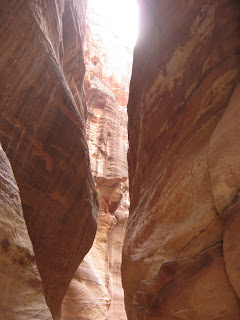 Canyon walls
 Westerners taking a ride through the canyon
 Multi-colored sides of the canyon wall
 Smiling camel
 Treasury from Indiana Jones fame (the door opens onto only one small room)
 Monastery (over 60 feet tall)
 View from the top of the mountain
 Placing a rock on the pile
 Top of the mountain with the Jordanian flag
Jamil was waiting for us when we reached the gate. We headed back along the King’s Highway, only this time at around 150 kilometers per hour (roughly 90mph) so that we could reach the border by 8 o’clock, otherwise we would have to spend the night in Jordan. Jamil was not pleased with us and was driving altogether too fast on the winding highway, making our stomachs lurch at every turn. As we headed down a mountain side, all of a sudden an animal flashed in the headlights (I could see very well from the front seat that it was a large dog), and the impact reverberated throughout the cabin as I yelled, “ohhh sh@!*&%$#t!” Jamil slammed on the brakes and pulled over to the side of the road. Enraged, he stepped from the car, slamming his door. He moved around to the front of the car to look at the damage. Tucker, seated in the back and the eternal pragmatist, said very level-headedly, “Well, we’ll probably have to give him a tip now.” Colette, also seated in the back, was in a different place entirely, “Did we hit a person?” I explained that, no, in fact it was a large dog. Meanwhile, Jamil headed back up the highway to see if the dog was dead and probably finish the job if his bumper had not. Whether we all like to admit it or not, we were all thinking what this Arab man was going to do, and this is where our socialization comes into play. Talking afterward, we all shared what we thought Jamil was going to do: I thought he would turn us out of his cab and make us walk, Tucker thought similarly that he might try to extract more money from us, Miriam said she was afraid that he wouldn’t go any further without compensation, and Colette, unabashedly, told us that she was contemplating texting her mother for possibly last time. I think all of us would admit that Colette’s thought passed through all of our minds, however briefly, merely because this man was an Arab. Jamil, however, although transparently angry, got us to the border on time and asked us for no extra payment. Such is the accuracy of prejudice and stereotype. As was only right, we gave him a large tip.
-N
 The end of the canyon opening up on the Treasury
 In the canyon
 Bedouin man's walk to work
 Canyon walls
 Westerners taking a ride through the canyon
 Multi-colored sides of the canyon wall
 Smiling camel
 Treasury from Indiana Jones fame (the door opens onto only one small room)
 Monastery (over 60 feet tall)
 View from the top of the mountain
 Placing a rock on the pile
 Top of the mountain with the Jordanian flag
Subscribe to:
Posts (Atom)